Refugee Claim in Canada , Focused Support for Complex and Time-Sensitive Cases
If you’re facing status pressure, feel unsure about the refugee claim process, or your file has reached a sensitive stage, clarifying the right direction early can significantly improve how well your case is prepared. Missing key timing windows can also narrow your options.
A4 International Immigration provides professional services led by a licensed Canadian immigration consultant (RCIC). We focus on refugee and protection-related matters that are more complex and require careful planning. We support clients in Metro Vancouver and across Canada with step-by-step preparation and ongoing file support.
Licensed RCIC (Canada)
Years of practical experience
Experience with complex files
Refugee Claim (Asylum)
For applicants who need protection, an RCIC first completes a feasibility assessment, then helps build a clear timeline and organize key evidence and application materials. Our focus is ensuring your personal statement and supporting documents are consistent and easy to understand, reducing the risk that unclear structure or narrative gaps weaken credibility.
Refugee Appeal
If the outcome is not what you expected, strategy matters most at the appeal stage. We review the key concerns rised in the original decision, then help reorganize the logic of the case, clarify what needs to be strengthened, and map out the next steps, so you understand what options remain and how to move forward.
Pre-Removal Risk Assessment (PRRA)
The core question in a PRRA is whether you can reasonably demonstrate risk if you return to your home country. We help organize your background explanation and supporting evidence to strengthen continuity and credibility, and we provide practical preparation guidance for common concerns raised during review.
Refugee Travel Document / Protected Person Travel Document
For people who have been granted protected status, we help explain eligibility, document preparation, and submission steps, and flag key considerations (for example, returning to your country of origin is generally not recommended). Common reasons for applying include travel and business. Processing times are often around one month, depending on the case.

Who We Typically Support
A4 International Immigration’s refugee and protection-related services primarily support people who are currently in Canada and facing status or risk-related pressure.
Based on our practical experience, many clients hold a visitor status, a study permit, or a work permit. Some are out of status, or have received removal-related notices, and need to clarify next steps within a limited time.
If any of the following apply, it’s usually best to seek an assessment early:
- Your status is expiring, or you’re having difficulty extending it
- You’ve received a removal order or other unfavourable notice
- You’re unsure whether you may qualify for a refugee claim or PRRA
- You previously filed on your own, and the materials are disorganized
- You feel unprepared for the hearing process or evidence requirements
Our role is not simply to say “yes or no.” We help you understand your current situation, feasible options, and key risks, then decide whether and how to move forward. With early assessment and structured preparation, you can reduce avoidable issues at critical stages. Results depend on individual circumstances.
Why Refugee Files Often Get Stuck
Many refugee claims don’t run into trouble because of eligibility alone, but because structural issues build up during preparation. Common challenges include scattered evidence, inconsistent personal statements, unclear timelines, or limited understanding of the hearing process, leading to high stress during the hearing and potentially harming the outcome.
We also frequently see files that were self-submitted or transferred mid-process. In these situations, documents may have inconsistent tone, factual gaps, or additional submissions that do not properly support the original narrative. These issues may not look serious at the start, but they are often examined closely as the case proceeds.
When information is scattered and time pressure is high, applicants may struggle to identify what truly affects the outcome. Preparation can become “patchwork fixes” instead of a complete, coherent structure.
What is PRRA most commonly challenged on?
Concerns often focus on whether you can demonstrate a high level of risk upon return, and whether your evidence aligns with your personal statement. If the materials lack continuity, overall credibility can be weakened.
Most common reasons refugee cases fail
Based on your practical experience, common issues include insufficient evidence, inconsistent testimony, and unclear or disorganized life events/narratives.
The most overlooked risk in refugee cases
Many applicants focus on how many documents they have, but overlook whether the materials actually support each other and remain consistent. If your statement, timeline, and evidence do not form a clear, coherent whole, even a large volume of documents can still be questioned, reducing overall persuasiveness.
Key Differences Between Strong vs. Weak Refugee Cases
Refugee claims often depend on three core factors:
- Evidence that supports a risk of harm if you return
- A narrative that is truthful and consistent
- Reasons for fearing return that have a real, factual basis
Common reasons cases get blocked include:
- Insufficient evidence
- Inconsistent statements or testimony
- Disorganized or unclear timelines and experiences
These are also the areas we most often help clients strengthen and restructure.

How We Work (A4 International Immigration Process)
For refugee and PRRA matters, we focus on complex files and have helped clients achieve positive outcomes, including successful appeals and approved PRRA results. Our work centres on strategy, document structure, and hearing preparation, not simply submitting forms. Before key procedures, we also provide one-on-one hearing preparation and mock sessions to help you become familiar with the process.
Case Assessment (RCIC)
Clarify your status, feasible direction, and key risk factors
Strategy Planning
Set priorities and sequencing so you don’t miss critical timing
Document & Evidence Integration
Build a clear timeline and evidence structure for consistency and clarity
Key Procedure Preparation
One-on-one preparation and mock hearing guidance, as appropriate
Typical deliverables:
Document checklist
Document organization support
Clear timeline
Evidence collection and integration
One-on-one mock hearing preparation
Processing timelines for refugee matters are commonly about 1–2 years (depending on the case). If evidence is strong, some files may move faster through paper-based review, depending on the process used.
Real Case Results
Based on the case materials you provided, outcomes we have helped clients achieve include:
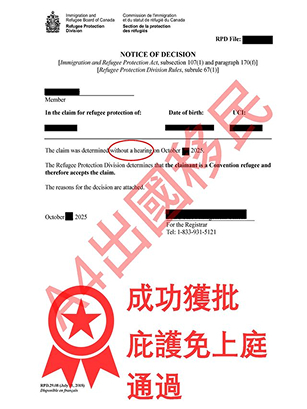
- Notice of Decision
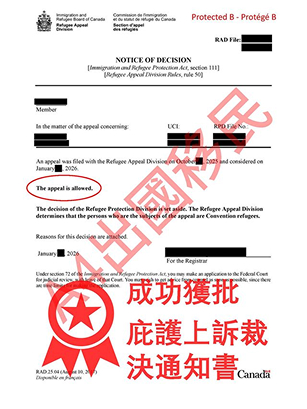
- Appeal Allowed
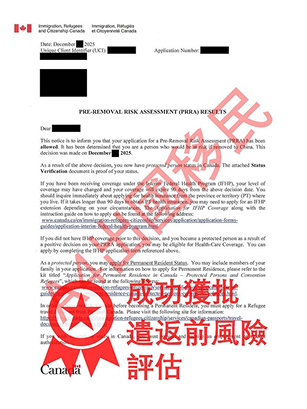
- PRRA Approved
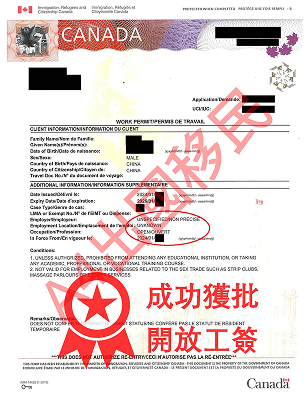
All displayed documents are de-identified and provided only as examples of case types. Every case is different and outcomes depend on individual circumstances.
Successful Case – Family of Three
Applicant Background:
A young couple with one minor child. Their refugee claim was approved within 9 months.
In April 2024, the family of three entered Canada as visitors. In the same month, they consulted our firm. On May 6, 2024, they submitted their refugee claim. Nine months later, in February 2025, they passed their hearing and were approved as “Protected Persons.” In March 2025, they submitted their permanent resident (PR) card application.
Exceptional Success Case – Single Young Adult
Applicant Background:
In early 2023, the applicant retained another immigration company in Toronto to submit a refugee claim. In mid-2024, the claim was refused. In September 2024, the appeal was dismissed by the Refugee Appeal Division (RAD), and the applicant was deemed “not credible.”
In January 2025, the applicant consulted our firm. In December 2025, he successfully passed the Pre-Removal Risk Assessment (PRRA) and was approved as a “Protected Person.” In January 2026, he submitted his permanent resident (PR) card application.
Successful Case Without Hearing – Single Young Adult
Applicant Background:
In September 2024, the applicant entered Canada in Winnipeg on a student visa to study. In November of the same year, he consulted our firm, and on December 13, 2024, he submitted his refugee claim.
After 9 months, the claim was approved without a hearing, and in October 2025 he was granted “Protected Person” status. In November 2025, he submitted his permanent resident (PR) card application.
Contact A4 International Immigration
If you are currently:
- Unsure whether a refugee claim is the right option
- Dealing with a complex file
- Facing a refusal or needing a remedy strategy
- Under serious status or timing pressure
It’s best to seek a professional assessment early.